
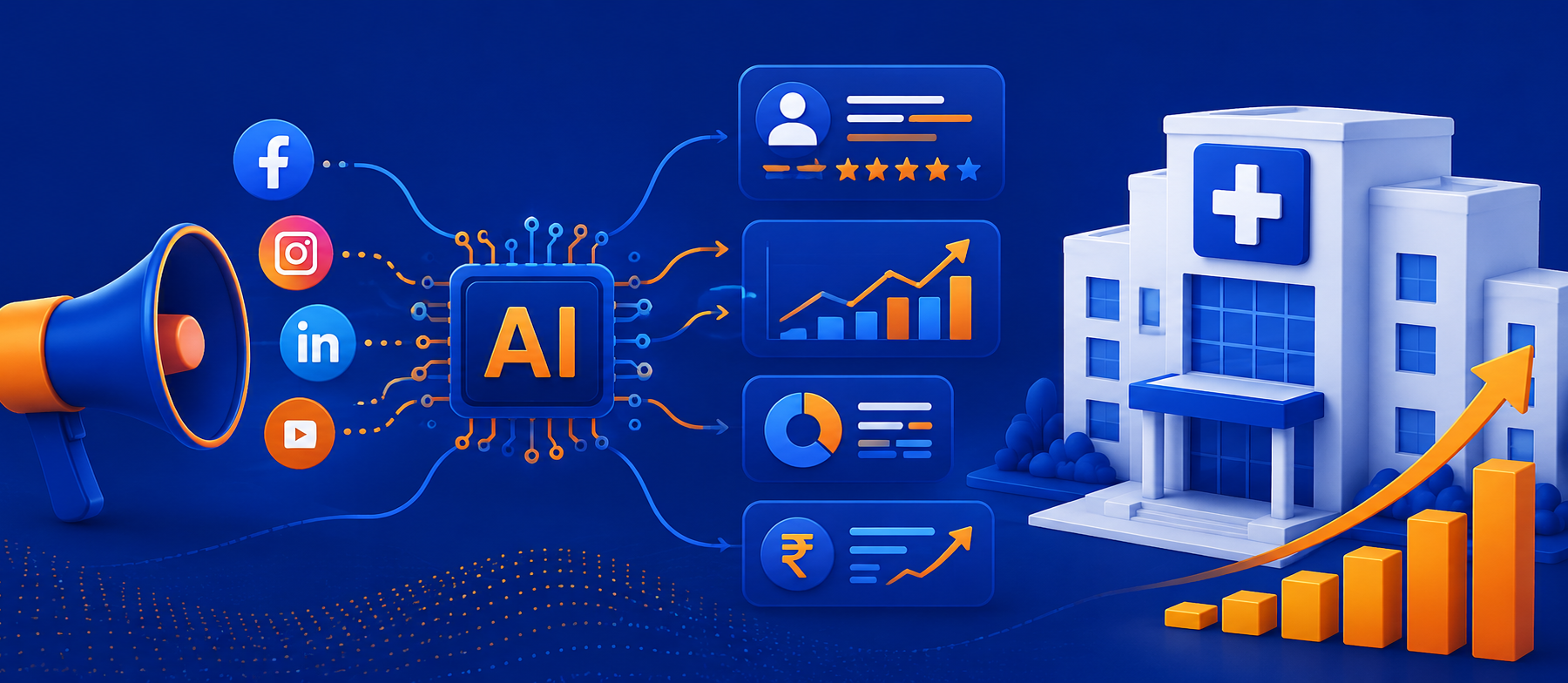
Hospital marketing has changed a lot over the last few years. Earlier, most hospitals depended on traditional advertising to attract patients. Billboards, newspaper ads, radio promotions and outdoor branding were enough to stay visible in the local market. Even when digital marketing became popular, many hospitals still relied on broad campaigns and manual decision-making.
That approach is no longer enough.
Today, patients search online before making healthcare decisions. They compare hospitals, look for specialists, read reviews, visit websites, and expect quick responses. Every one of these actions creates data. Hospitals that use this data effectively are achieving better results from their marketing efforts. This is where AI is starting to play a major role in performance marketing for hospitals.
Hospital Marketing Is Becoming More Data-Focused
Hospitals now collect data from multiple sources every day, including:
• Google Ads campaigns
• Website traffic
• Appointment forms
• CRM systems
• Social media campaigns
• Patient engagement platforms
The challenge is not collecting the data. The real challenge is understanding what the data actually means and using it to improve marketing decisions.
Many hospitals still run campaigns based on assumptions. Budgets are fixed for weeks. Audiences stay broad. Ads continue running even when performance drops.
AI helps hospitals move away from guesswork
• Instead of waiting for monthly reports, marketing teams can now understand what is working in real time. This makes campaigns more flexible, faster, and more efficient.
• That is one reason why performance marketing for hospitals is evolving so quickly in 2026.
AI Helps Hospitals Reach the Right Patients
• One of the biggest benefits of AI is better targeting.
• Not every person searching online is ready to book an appointment. Some people are only researching symptoms, while others are actively looking for treatment options or specialists.
AI tools can study patterns like:
• Search behavior
• Website visits
• Location signals
• Device usage
• Appointment history
• Seasonal healthcare trends
This helps hospitals identify high-intent audiences more accurately
• For example, someone repeatedly searching for orthopaedic treatments, recovery timelines and specialist reviews is far more likely to book a consultation than someone casually browsing health content.
• Instead of showing ads to large random audiences, hospitals can focus their budgets on people who are more likely to convert.
• That leads to stronger patient acquisition and lower wasted ad spend.
Predictive Analytics Is Improving Campaign Decisions
Traditionally, hospitals reviewed campaign performance only after the campaign ended.
By then, a large part of the budget was already spent.
AI is changing that through predictive analytics.
• Modern AI systems can help hospitals understand:
• Which campaigns are likely to perform well
• Which audiences may convert faster
• When healthcare demand may increase
• What patient acquisition costs could look like
• Which services may see seasonal spikes
This allows marketing teams to make adjustments earlier instead of reacting too late. For hospitals working with limited budgets, small improvements in targeting and timing can make a big difference.
Paid Advertising Is Becoming Smarter
Platforms like Google and Meta already use machine learning heavily inside their advertising systems.
Today, AI helps optimise:
• Ad placements
• Bid strategies
• Audience delivery
• Budget allocation
• Conversion tracking
Earlier, marketers manually adjusted campaigns every few days. Now, AI systems make small optimisations continuously using real-time data
Hospitals are also using AI to automatically test different ad creatives.
For example, systems can compare:
• Different headlines
• Multiple CTAs
• Image variations
• Video formats
• Messaging styles
Over time, the platform learns which combinations generate more appointment requests and improves campaign delivery automatically.
Patients Expect Personalised Experiences
• Generic healthcare ads are becoming less effective.
• Patients now expect hospitals to understand what they are looking for and provide relevant information.
AI makes this possible at scale.
• Someone researching maternity care may later see pregnancy-related educational content. A patient searching for knee replacement options may receive orthopaedic-focused ads or recovery resources.
• Even simple personalisation improves engagement because the communication feels more relevant to the patient’s needs.
• Healthcare marketing is slowly becoming more patient-centred instead of purely promotional.
AI Chatbots Are Helping Hospitals Respond Faster
Speed matters a lot in healthcare inquiries. Many hospitals lose potential patients simply because responses are delayed. AI-powered chat systems are helping hospitals solve this problem by:
• Answering basic patient questions instantly
• Helping users book appointments
• Sharing doctor availability
• Collecting lead information
• Routing patients to the correct department
These systems work throughout the day without depending entirely on call centre teams.
For patients, faster responses create a better experience. For hospitals, it increases the chances of converting inquiries into appointments
Marketing Performance Is Easier to Measure
One of the biggest challenges in hospital marketing has always been attribution
Hospitals often struggled to understand:
• Which campaigns actually generated appointments
• Which ads influenced patient decisions
• Which channels produced higher-value patients
AI tools are making this process clearer.
Marketing teams can now track:
• Cost per appointment
• Return on ad spend
• Engagement quality
• Patient conversion patterns
• Long-term campaign performance
This helps hospitals make decisions based on real data instead of assumptions
Human Trust Still Matters
• Even with all the advantages of AI, healthcare marketing cannot become fully automated.
• Hospitals still need to handle patient trust carefully.
• Privacy, ethical communication and transparency remain extremely important. Patients are sharing sensitive information, and hospitals must use technology responsibly.
• AI should improve patient experience, not make communication feel robotic or manipulative.
• The hospitals that succeed will be the ones using technology to support human connection, not replace it.
The Future of Performance Marketing for Hospitals
- AI is not replacing hospital marketing teams. It is helping them make better decisions faster.
- From smarter targeting and automated advertising to personalisation and campaign optimisation, AI is changing how hospitals attract and engage patients online.
- At the same time, the fundamentals still matter. Patients want trust, clarity, fast communication and relevant information.
- Hospitals that combine strong patient experience with intelligent marketing strategies will continue to grow in an increasingly competitive healthcare market.
- The future of performance marketing for hospitals will belong to organisations that know how to use both technology and human understanding together.