
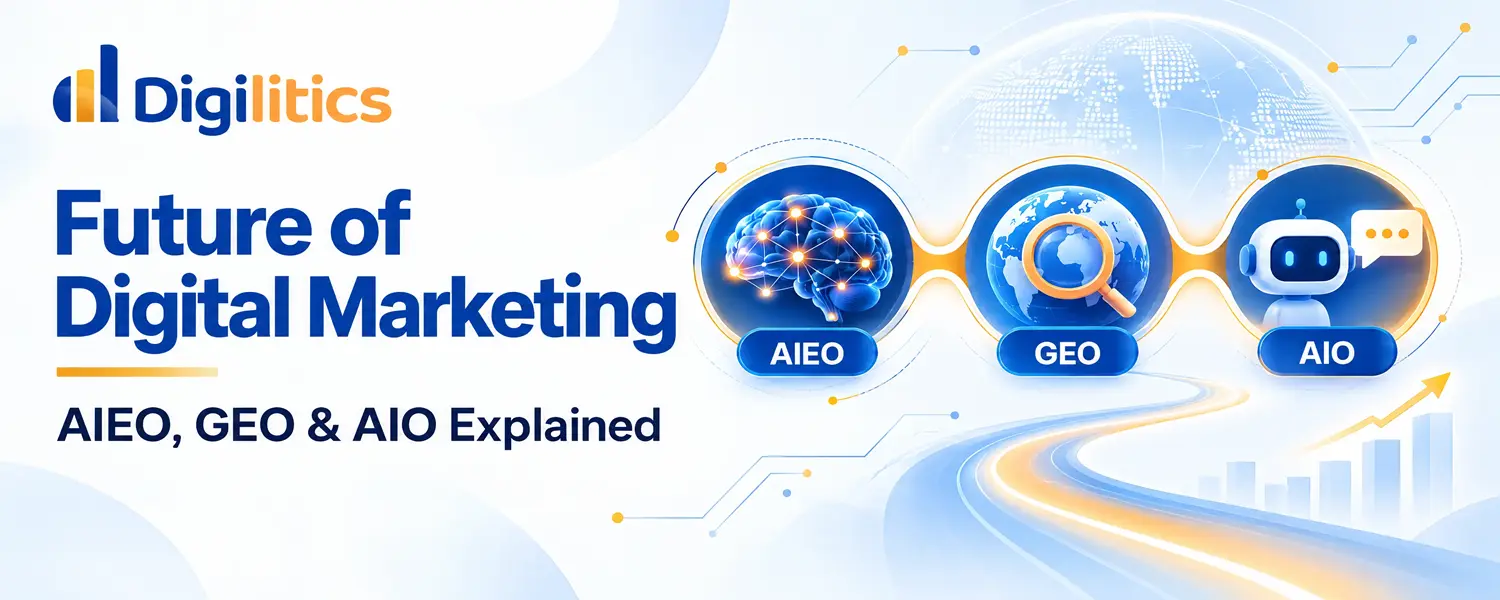
The future of digital marketing is no longer a slow evolution. It is a sharp shift. Search is changing. Content is changing. Even how people discover brands is changing. If your strategy still looks like it did a few years ago, you are already behind.
Today, users do not just search. They ask. They expect instant, clear answers. AI now sits between your brand and your audience. That single change is rewriting the future of digital marketing in ways most businesses are only beginning to understand.
This is where concepts like AIEO, GEO, and AIO come into play.
Why the future of digital marketing looks different now
Earlier, digital marketing success was driven by rankings, reach, and frequency. Now it is driven by relevance, trust, and understanding.
AI-powered search engines summarize content instead of listing links. Social platforms prioritize meaningful engagement over volume. Audiences reward clarity, not complexity.
The future of digital marketing is about being useful, not just visible.
This is why AI-driven SEO strategies are becoming central to modern growth plans.
What AIEO really means
AIEO stands for AI Engine Optimization. It focuses on optimizing content so AI systems can understand, trust, and surface it directly in answers.
In the future of digital marketing, ranking alone is not enough. Your content must be readable and usable by AI.
AI search optimization under AIEO focuses on:
- Clear structure
- Direct answers
- Strong expertise signals
- Trustworthy information
This shift is redefining how brands approach visibility.
Understanding GEO and why it matters
GEO refers to Generative Engine Optimization. This is about optimizing content so it can be used by generative AI models when they create summaries, explanations, and recommendations.
In simple terms, GEO decides whether your content gets used or ignored by AI.
Generative search optimization focuses on:
- Depth instead of fluff
- Context instead of keywords
- Accuracy instead of exaggeration
The future of digital marketing depends heavily on GEO because generative answers are becoming the default way people consume information.
AIO and the role of optimization beyond SEO
AIO stands for AI Optimization. It goes beyond search.
AIO applies to:
- Content creation
- Distribution
- Personalization
- Performance analysis
AI content optimization ensures that messaging adapts to user intent while staying consistent with brand voice.
In the future of digital marketing, AIO helps brands scale without losing clarity.
How AI search optimization changes content creation
Content is no longer written only for humans or only for algorithms. It must work for both.
AI search optimization rewards content that:
- Answers one core question clearly
- Uses simple language
- Shows real expertise
- Stays updated
This approach supports both AI-driven SEO strategies and generative search optimization.
Instead of creating ten shallow blogs, brands now win by creating one deeply useful resource.
Why traditional SEO alone is no longer enough
Traditional SEO focused on keywords, backlinks, and technical tweaks.
While these still matter, the future of digital marketing requires more.
AI systems evaluate:
- How well content solves a problem
- Whether it demonstrates experience
- How trustworthy the source appears
AI-driven SEO strategies blend traditional SEO with content quality, authority, and structure.
This is the new baseline, not an advanced tactic.
Content structure is now a competitive advantage
AI reads structure before style.
To align with AI content optimization:
- Use clear headings
- Keep paragraphs focused
- Avoid unnecessary filler
- Summarize complex ideas simply
These practices improve AI search optimization and increase chances of being featured in AI-generated answers.
Structure helps machines understand and humans trust.
The role of trust in the future of digital marketing
Trust has always mattered. Now it is measurable.
AI evaluates trust through:
- Author credibility
- Content consistency
- Accuracy over time
- Brand reputation
This is why AI-driven SEO strategies emphasize authority and experience.
In the future of digital marketing, brands that publish unclear or misleading content will slowly disappear from AI-driven visibility.
What marketers need to unlearn
To adapt to the future of digital marketing, some habits must be dropped.
These include:
- Writing only for rankings
- Chasing every new trend
- Overusing automation without review
- Creating content without real insight
Generative search optimization rewards patience and depth, not shortcuts.
How to prepare for what comes next
To stay relevant, brands should:
- Invest in AI content optimization tools thoughtfully
- Build subject matter expertise
- Focus on quality over volume
- Document brand knowledge clearly
AI search optimization is not a one-time fix. It is an ongoing system.
The future of digital marketing belongs to brands that treat AI as a collaborator, not a hack.
Measuring success in an AI-driven world
Success is no longer just traffic.
In the future of digital marketing, success looks like:
- Being cited by AI tools
- Increased brand recall
- Stronger trust signals
- Consistent engagement
AI-driven SEO strategies help track these indicators beyond traditional metrics.
Final thoughts
The future of digital marketing is being shaped right now. AIEO, GEO, and AIO are not buzzwords. They are frameworks for how visibility, trust, and growth will work going forward.
Brands that embrace AI search optimization, invest in generative search optimization, and apply AI content optimization thoughtfully will stay relevant. Those that do not will slowly fade from discovery.
The rules have changed. But the goal remains the same.
Be genuinely useful. Be trustworthy. Be clear.
That is the real future of digital marketing.